

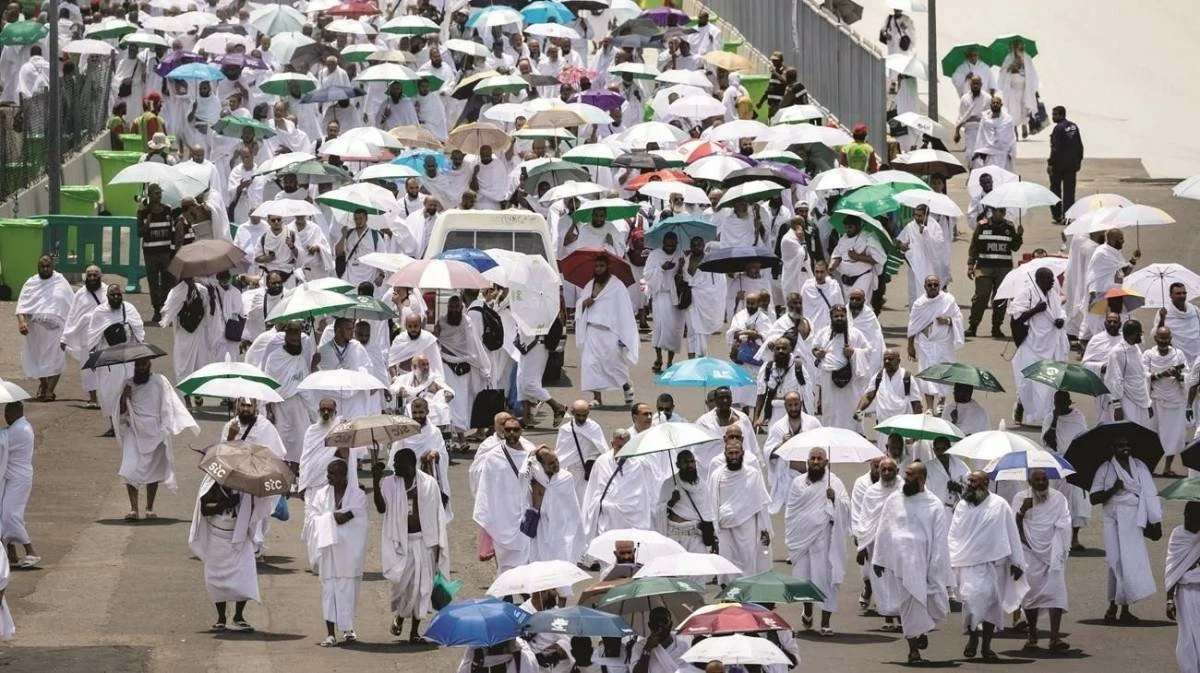
Dubai: Hajj is one of the largest annual human gatherings in the world, and the Kingdom of Saudi Arabia has been documenting pilgrim numbers and issuing official statistics for decades to support planning, organisation and service development for pilgrims.
Based on historical data from Saudi official authorities and estimated figures, the total number of pilgrims since the start of official records in 1970 up to the 2026 season has exceeded 106 million. This reflects continuous growth in pilgrim numbers and significant development in the Hajj system over more than five decades.
Saudi Arabia began officially documenting pilgrim figures in 1970, when the number exceeded one million for the first time, reaching 1,079,760. During the 1970s, Hajj seasons saw rapid growth, with numbers rising to 1.8 million in 1978. In 1979, the figure surpassed two million for the first time, reaching 2,079,689 pilgrims.
Numbers continued to rise during the 1980s and 1990s, with the 1983 season recording more than 2.5 million pilgrims. In subsequent years, figures stabilised between 1.6 and 2 million due to ongoing organisation and expansion projects in the holy sites.
With the start of the new millennium, growth resumed, exceeding 2.4 million pilgrims in 2007. The highest number was recorded in 2012, with more than 3.1 million pilgrims.
In later years, numbers declined slightly due to expansion works. The COVID-19 pandemic marked a historic disruption, with only 1,000 pilgrims allowed in 2020 and 58,000 in 2021 to protect public health.
Following the pandemic, numbers gradually recovered, reaching 1.8 million in 2024, 1.67 million in 2025, and approximately 1.5 million in 2026.
Accurate and systematic documentation of pilgrim numbers has played a key role in improving planning, organisation and the development of health, security, transport and crowd management services at the holy sites.
It has also supported future expansion plans for the Two Holy Mosques and improved the efficiency of services in line with increasing pilgrim numbers.
In recent years, Hajj has seen significant advances in technology, including smart service applications, advanced transport systems and electronic permit platforms, all of which have enhanced operational efficiency and improved safety and services for pilgrims.