

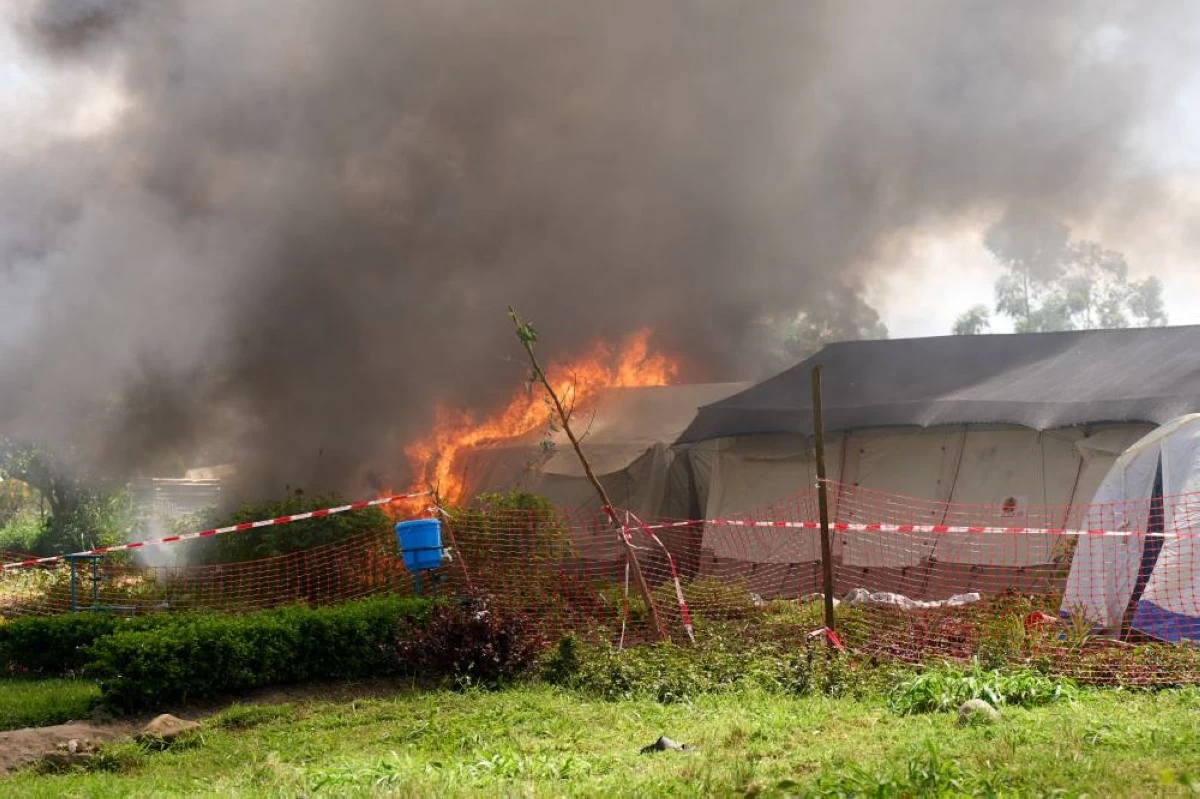
Congo: Arson attacks on Ebola treatment centres in eastern Congo have exposed the complex challenges facing authorities as they attempt to contain an outbreak of an infectious disease declared a global health emergency.
The burning of centres in two towns at the heart of the outbreak highlights growing anger in a region already affected by armed conflict, mass displacement, weak governance and cuts to international aid. Experts warn that these overlapping crises are significantly undermining the health response.
“A devastating set of emergencies are converging,” said the nonprofit Physicians for Human Rights.
Eastern Congo has long been plagued by violence involving dozens of rebel groups, some with links to Islamic State. The Rwanda-backed M23 rebels control parts of the region, while the Congolese government maintains only limited authority in the northeastern Ituri Province, where the outbreak is centred. The Allied Democratic Forces, a Ugandan Islamist group linked to Islamic State, continue to carry out attacks on civilian targets.
Even before the outbreak, insecurity had disrupted healthcare services. Doctors Without Borders reported worsening conditions in Ituri, with medical staff fleeing violence, leaving facilities overwhelmed and, in some areas, facing “catastrophic” conditions.
Conflict has displaced nearly one million people in Ituri, according to the United Nations, creating conditions that make disease control far more difficult. The outbreak is unfolding in communities already weakened by insecurity, displacement and fragile healthcare systems.
Authorities have reported more than 700 suspected Ebola cases and over 170 suspected deaths, mostly in Ituri. Cases have also been identified in North Kivu and South Kivu, areas partly controlled by M23 rebels, as well as in neighbouring Uganda. This has led to a fragmented response, with different areas managed by government authorities, rebel groups and a range of aid organisations.
Health experts say that cuts to international aid, particularly from the United States and other wealthy nations, have significantly reduced the region’s ability to respond effectively. These reductions have limited disease detection and response capabilities, further weakening an already strained system.
Aid workers on the ground report severe shortages of essential supplies, including protective equipment, testing kits and materials needed for safe burials. Some facilities are operating with only basic items such as hand sanitiser and a limited number of masks.
The outbreak involves the Bundibugyo strain of Ebola, for which there is no approved vaccine or treatment, adding to the difficulty of controlling its spread.
The destruction of treatment centres in Rwampara and Mongbwalu — areas with the highest number of cases — also reflects deep mistrust among local communities. Years of violence, perceived neglect by authorities and frustration with international interventions have contributed to scepticism and anger.
In one incident, a group of youths set fire to a treatment centre in Rwampara while attempting to retrieve the body of a friend. Witnesses said the crowd accused aid workers of misrepresenting the disease.
Strict burial protocols have further heightened tensions. To prevent transmission, authorities have taken control of funeral arrangements, limiting traditional practices. This has led to resentment among families and communities.
In response, authorities in northeastern Congo have banned funeral wakes and gatherings of more than 50 people. Security forces have also been deployed to guard burials carried out by aid workers.
As the outbreak continues, the combination of violence, mistrust, displacement and limited resources is complicating efforts to contain the disease, raising concerns about its further spread in one of the world’s most fragile humanitarian settings.